An SPC flooring extrusion line converts a blended mixture of PVC resin, calcium carbonate, stabilizers, and other additives into a rigid flooring core sheet. The process involves material preparation, twin-screw extrusion, die forming, calendering, optional online lamination and embossing, controlled cooling, edge trimming, and cutting.
For flooring manufacturers, the key is not simply to extrude material as quickly as possible. The production line must maintain stable melt flow, uniform sheet thickness, reliable layer bonding, and controlled cooling to produce consistent SPC flooring boards. SKY WIN's SPC flooring extrusion equipment is designed to integrate these processes into a continuous manufacturing system.
What Is an SPC Flooring Extrusion Line?
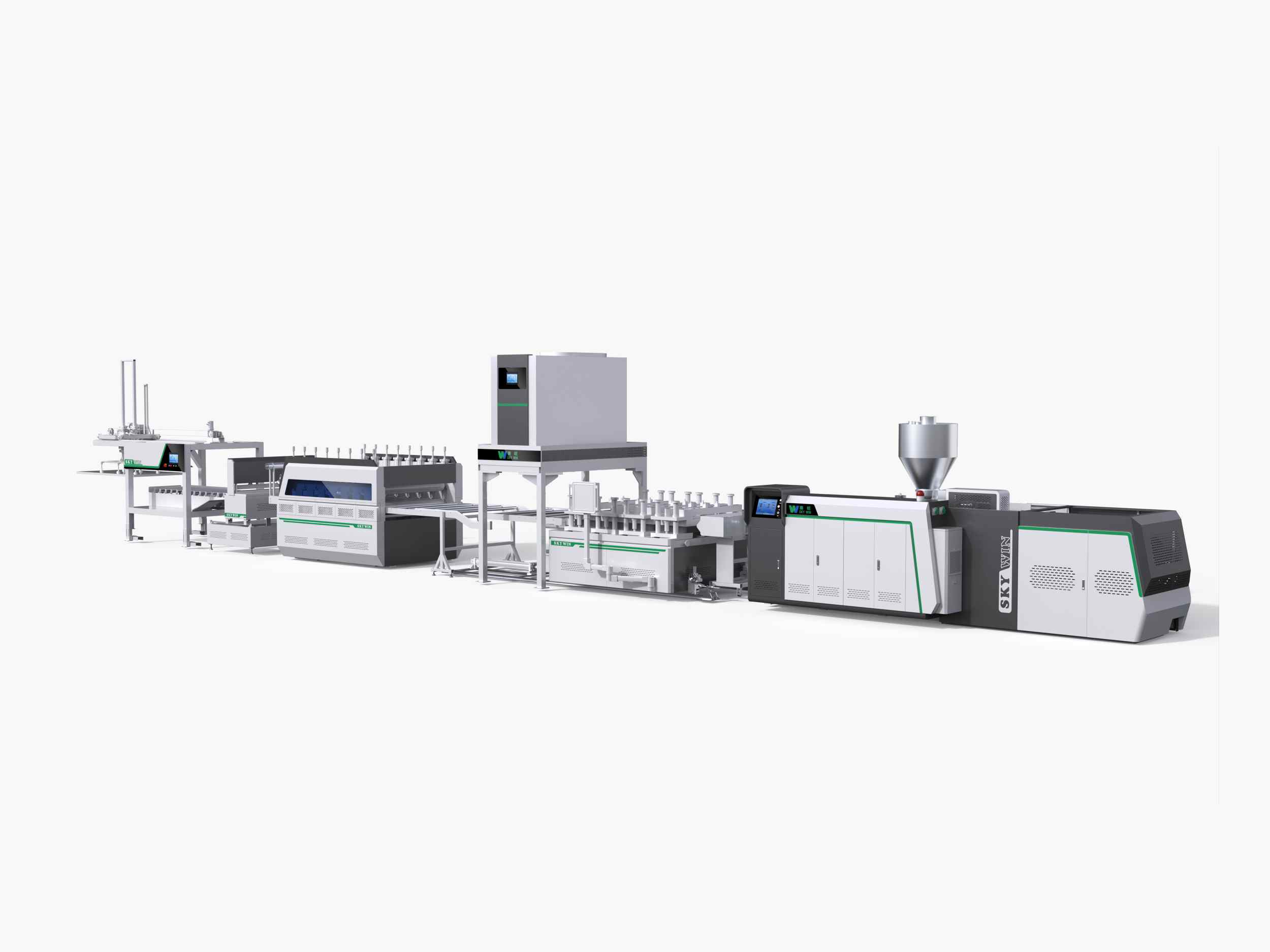
An SPC flooring extrusion line is a complete manufacturing system that processes a rigid PVC-based composite into continuous sheets used to make stone plastic composite flooring. SPC stands for Stone Plastic Composite, referring to the combination of PVC and mineral filler, commonly calcium carbonate, used to create a rigid core.
Unlike a standalone extruder, a complete SPC production line includes the equipment needed to form, finish, cool, and cut the sheet. Depending on the configuration, it can also include online lamination and embossing systems that apply decorative films and surface textures during continuous production.
A typical SPC flooring extrusion line includes:
- Material mixing system: Prepares PVC resin, calcium carbonate, stabilizers, and other additives.
- Conical twin-screw extruder: Plasticizes and homogenizes the compound before extrusion.
- Extrusion die: Distributes the melt across the required sheet width.
- Calendering and lamination system: Controls sheet thickness and can integrate decorative layers.
- Cooling system: Removes heat and helps the sheet maintain dimensional stability.
- Haul-off and edge trimming units: Control sheet movement and trim uneven edges.
- Automatic cutting system: Cuts the continuous sheet into specified lengths.
SKY WIN's SPC/PVC Flooring Sheet Extrusion Line uses a high-torque conical twin-screw extruder. Its listed configuration includes a five-roll laminator, laminating unit, oil-heated roll system, cooling equipment, edge trimmer, haul-off unit, high-speed sheet cutter, and electrical control system.
How Does the SPC Flooring Extrusion Process Work?
The SPC flooring manufacturing process follows a series of connected stages. Each stage affects the next one, so the extruder, calender, cooling section, and cutting equipment must operate at compatible speeds and processing conditions.
Material preparation → Twin-screw extrusion → Die forming → Calendering and optional lamination → Cooling → Edge trimming → Cutting.
The exact process depends on the flooring structure, formulation, and selected equipment configuration. For example, online lamination may combine the decorative film and wear layer with the hot core sheet, while some production setups use separate downstream finishing processes.
Material Mixing: Preparing the SPC Compound
The first step is preparing a consistent compound. Typical SPC formulations contain PVC resin, calcium carbonate, stabilizers, and other processing additives. The proportions depend on the required core rigidity, density, processing behavior, and finished flooring specifications.
Uniform mixing matters because inconsistent material distribution can cause variations in extrusion behavior, sheet thickness, surface appearance, and mechanical properties. Moisture, raw material quality, mixing temperature, and the consistency of the feeding process also need to be controlled.
Before the compound enters the extruder, manufacturers should verify that the formulation and material preparation process are suitable for the selected screw configuration and target output. Changing the filler loading or additive package may require adjustments to processing conditions.
Twin-Screw Extrusion: Plasticizing the Material
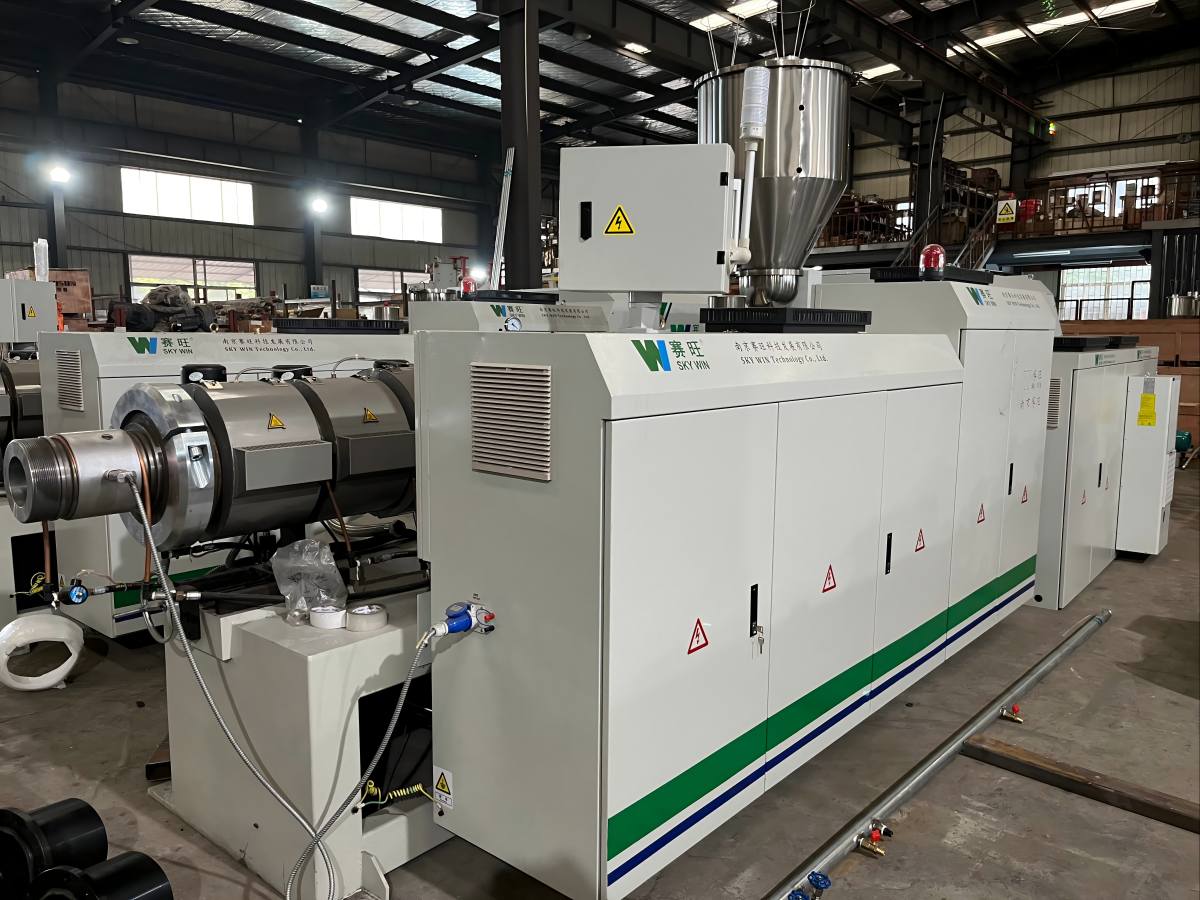
The extruder is the central component of an SPC flooring production line. It receives the prepared compound, applies heat and mechanical energy, and produces a homogeneous melt that can be continuously formed into a sheet.
SKY WIN uses a conical twin-screw configuration for its SPC flooring extrusion equipment. This design is intended to support the mixing and plasticizing of PVC-based compounds containing mineral fillers.
During extrusion, several operating factors affect production stability:
- Screw design and torque: Must match the formulation, filler loading, and required output.
- Temperature control: Helps maintain suitable plasticization while limiting excessive heat exposure.
- Feeding consistency: Reduces fluctuations in material supply and extrusion output.
- Wear resistance: Matters because mineral fillers can increase abrasive wear on processing components.
If plasticization is inconsistent, the line may experience unstable output, rough surfaces, or thickness variations. Simply increasing screw speed is not always the best solution because the downstream equipment must also be able to handle the additional material flow.
For manufacturers comparing equipment options, SKY WIN's PVC Flooring SPC/LVT Sheet Extrusion Line provides another product configuration to evaluate according to the required flooring structure, sheet dimensions, and production capacity.
Die Forming and Calendering: Controlling Sheet Thickness
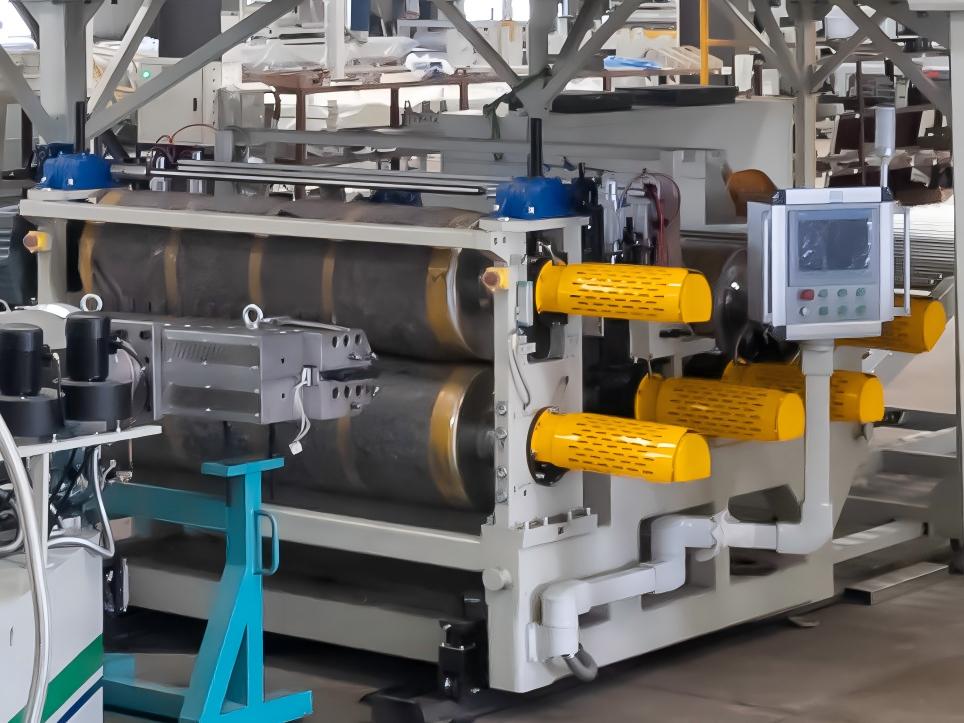
After plasticization, the molten composite passes through an extrusion die, which distributes the material across the required width and forms a continuous sheet. The sheet then enters the calendering system, where rollers help control its thickness, flatness, and surface characteristics.
Consistent die flow and roller settings are essential for maintaining uniform thickness across the sheet. If the material distribution is uneven or the rollers are not properly adjusted, the finished core may show thickness deviations, uneven edges, or surface defects.
Important process variables include die temperature, die-lip adjustment, roller temperature, roller gap, and line speed. These settings should be established according to the material formulation and target sheet dimensions rather than copied from another production setup.
For SPC flooring manufacturers, a stable calendering process also helps prepare the sheet for subsequent cooling and finishing. The extruder and calender should therefore be treated as a coordinated system, not as independent machines.
Online Lamination and Embossing: Adding the Flooring Surface
When the production line is configured for online lamination, decorative film and a wear layer can be bonded to the core sheet during continuous processing. Embossing equipment can also create the required surface texture.
Online lamination can reduce the need for a separate lamination stage, depending on the factory's production process. It can also help manufacturers coordinate core-sheet forming and surface finishing within one integrated line.
Successful lamination depends on several factors:
- The temperature of the core sheet and laminating rollers.
- The compatibility of the decorative film, wear layer, and core material.
- Roll pressure and contact conditions.
- Line speed and the time available for bonding.
- Embossing settings and the desired surface texture.
Incorrect settings may lead to bubbles, weak bonding, uneven textures, or surface damage. The process should be tested with the actual film and core formulation before full-scale production.
SKY WIN's SPC flooring equipment provides separate control for online lamination and embossing. This configuration allows manufacturers to adjust these functions according to their surface-finishing requirements.
Cooling and Haul-Off: Maintaining Dimensional Stability
After forming and any online surface treatment, the hot SPC sheet must be cooled in a controlled manner. Cooling helps the composite stabilize before it is trimmed and cut. Inadequate or uneven cooling can contribute to warping, residual stress, and dimensional variations.
The cooling system must match the line's output and sheet dimensions. A higher-capacity extruder does not automatically produce higher-quality flooring if the downstream cooling section cannot remove heat at the required rate.
The haul-off unit also plays an important role. It pulls the sheet through the production line at a controlled speed and must remain synchronized with the extruder and calender. Unstable pulling or speed mismatches can affect sheet dimensions and surface quality.
For this reason, manufacturers should evaluate cooling capacity and haul-off performance when selecting an SPC flooring extrusion machine, especially when planning high-output production.
Edge Trimming and Cutting: Preparing the Sheet for Further Processing
Once the sheet has reached a suitable temperature and dimensional stability, the edge trimming unit removes uneven edges. The cutting machine then divides the continuous sheet into specified lengths for subsequent flooring processing.
Cutting accuracy depends on consistent sheet movement, correct length settings, and coordination between the haul-off and cutter. Poor synchronization can cause length variations, uneven cut edges, or unnecessary material waste.
Some factories also use automated stacking and additional downstream equipment, depending on whether they produce core boards, laminated sheets, or finished flooring products. The complete line should be configured around the factory's intended production stages.
SKY WIN's PVC/WPC Flooring Base Material Extrusion Line is another option for manufacturers evaluating equipment for flooring base-layer production. Its suitability depends on the material and structure of the intended product.
What Production Capacity Can an SPC Flooring Extrusion Line Achieve?
The output of an SPC flooring extrusion line depends on the extruder model, material formulation, sheet thickness, sheet width, line speed, and downstream processing capacity. Rated output should always be considered alongside the product specification used to achieve it.
SKY WIN publishes the following model ranges for its SWDB5 series:
| Specification | Published range |
|---|---|
| Sheet thickness | 1.5–7 mm |
| Sheet width | 970–1220 mm |
| SWDB5-2 rated output | 600–800 kg/h |
| SWDB5-3 rated output | 1100–1400 kg/h |
| SWDB5-4 rated output | 2500–2900 kg/h |
| SWDB5-6 rated output | 3000–4000 kg/h |
These are published model specifications, not a guarantee of actual production output under every operating condition. Before choosing a model, ask the supplier to confirm achievable output using your intended formulation, sheet thickness, sheet width, and surface-layer configuration.
How to Choose an SPC Flooring Extrusion Line for Your Factory
The right SPC flooring extrusion line should match your production plan rather than simply offer the highest rated output. Before requesting a quotation, define the product specifications and the level of automation required for your factory.
Consider these factors when comparing equipment:
- Target product: Confirm whether you will produce SPC core sheets, laminated sheets, or a more complete flooring product.
- Sheet dimensions: Specify the required thickness, width, and cutting length.
- Formulation: Provide the PVC resin, calcium carbonate, and additive formulation or its main processing requirements.
- Production target: Estimate the required hourly output and expected operating schedule.
- Surface treatment: Confirm whether online lamination and embossing are needed.
- Factory conditions: Check available space, power supply, cooling water, ventilation, and material-handling arrangements.
- Service support: Ask about installation, commissioning, operator training, spare parts, and maintenance.
If your factory also plans to manufacture flexible vinyl flooring, evaluate the process requirements separately. SKY WIN's LVT Flooring High-speed Extrusion Line is designed for LVT sheet production, but an LVT configuration should not be assumed to be interchangeable with an SPC line without engineering confirmation.
For manufacturers planning a new production project, providing detailed product specifications early helps the equipment supplier recommend a suitable extrusion, calendering, cooling, and cutting configuration.
Frequently Asked Questions About SPC Flooring Extrusion Lines
How does an SPC flooring extrusion line work?
An SPC flooring extrusion line blends PVC resin, calcium carbonate, stabilizers, and other additives, then uses a twin-screw extruder to plasticize the compound. The melt passes through a die to form a sheet, which is calendered, optionally laminated and embossed, cooled, trimmed, and cut to the required dimensions.
What raw materials are used in SPC flooring production?
SPC flooring commonly uses PVC resin, calcium carbonate, stabilizers, and other processing additives. The exact formulation depends on the desired rigidity, density, processability, and finished product properties.
Why is a conical twin-screw extruder used for SPC flooring?
A conical twin-screw extruder is designed to mix and plasticize PVC-based compounds containing mineral fillers. Its suitability depends on the formulation, required output, screw design, and processing conditions.
What is the role of the calendering system in SPC production?
The calendering system helps control sheet thickness, flatness, and surface quality. It may also support online lamination and embossing when these functions are included in the production line.
Why is cooling important in SPC flooring extrusion?
Controlled cooling helps the hot composite sheet stabilize before cutting and further processing. Insufficient or uneven cooling can contribute to warping, residual stress, and dimensional variations.
What is the production capacity of an SPC flooring extrusion line?
Capacity varies by model and operating conditions. SKY WIN's published SWDB5 series specifications range from 600–800 kg/h for the SWDB5-2 to 3000–4000 kg/h for the SWDB5-6. Actual output depends on the material formulation, sheet dimensions, and production configuration.
Can an SPC flooring extrusion line include online lamination and embossing?
Yes. Depending on the configuration, the line can integrate lamination and embossing with sheet extrusion. The required films, wear layer, surface texture, and processing conditions should be confirmed before equipment selection.
How do I select the right SPC flooring extrusion machine?
Start with the target flooring structure, material formulation, sheet thickness, width, required hourly output, and surface-finishing requirements. Then compare extruder capability, calendering, cooling, cutting, automation, and technical support.
SKY WIN provides SPC flooring extrusion solutions for manufacturers with different product specifications and output requirements. To identify a suitable configuration, prepare your target sheet dimensions, formulation, expected capacity, and lamination requirements before requesting a quotation.