Regarding faults in screw pumps, we at Anhui Shengshi Datang have some effective solutions.
First, ensure that no foreign objects enter the pump body.
If solid debris enters the pump body, it can damage the rubber stator of the progressive screw pump. Therefore, it is crucial to prevent debris from entering the pump chamber. Some systems install a grinder before the pump, while others use a screen or filter to block debris from entering the pump. Screens should be cleaned promptly to prevent clogging.
Second, avoid operating the pump without material.
The progressive screw pump absolutely must not run dry. If dry running occurs, the rubber stator can instantly overheat due to dry friction and burn out. Therefore, having a properly functioning grinder and clear screens are essential conditions for the normal operation of the pump. For this reason, some pumps are equipped with a dry-run protection device. When material supply is interrupted, the self-priming capability of the pump creates a vacuum in the chamber, which triggers the vacuum device to stop the pump.
Third, maintain a constant outlet pressure.
The progressive screw pump is a positive displacement rotary pump. If the outlet is blocked, the pressure will gradually rise, potentially exceeding the predetermined value. This causes a sharp increase in the motor load, and the load on related transmission components may also exceed design limits. In severe cases, this can lead to motor burnout or broken transmission parts. To prevent pump damage, a bypass relief valve is usually installed at the outlet to stabilize the discharge pressure and ensure normal pump operation.
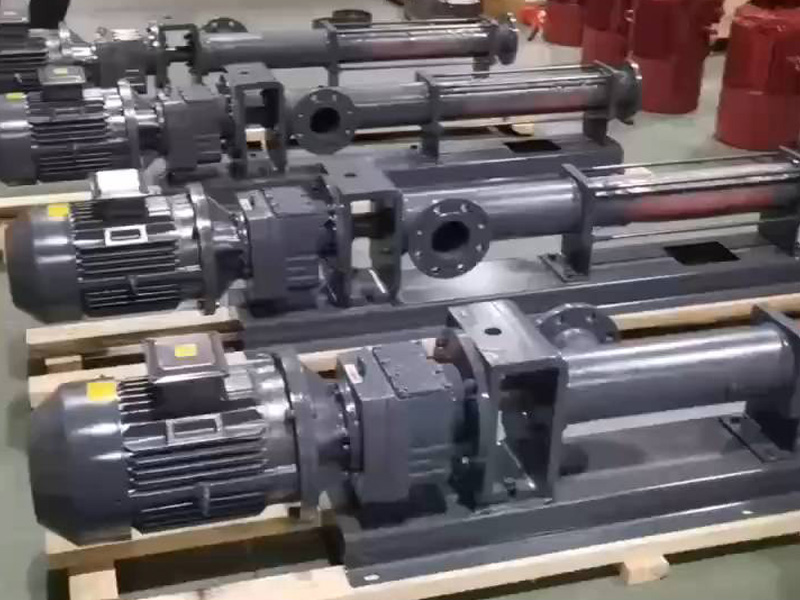
Fourth, reasonable selection of pump speed.
The flow rate of the progressive screw pump has a linear relationship with its speed. Compared to low-speed pumps, high-speed pumps can increase flow and head, but power consumption increases significantly. High speed accelerates the wear between the rotor and stator, inevitably leading to premature pump failure. Furthermore, the stator and rotor of high-speed pumps are shorter and wear out more easily, thus shortening the pump's service life.
Using a gear reducer or variable speed drive to reduce the speed, keeping it within a reasonable range below 300 revolutions per minute, can extend the pump's service life several times compared to high-speed operation.
Of course, there are many other maintenance methods for progressive screw pumps, which requires us to be more attentive during daily use. Careful observation will contribute significantly to proper pump maintenance.
How should faults in progressive screw pumps be handled? This article will mainly introduce methods for troubleshooting progressive screw pumps.
1. Pump body vibrates violently or produces noise:
A. Causes: Pump not installed securely or installed too high; damage to the motor's ball bearings; bent pump shaft or misalignment (non-concentricity or non-parallelism) between the pump shaft and the motor shaft.
B. Solutions: Secure the pump properly or lower its installation height; replace the motor's ball bearings; straighten the bent pump shaft or correct the relative position between the pump and the motor.
2. Transmission shaft or motor bearings overheating:
A. Causes: Lack of lubricant or bearing failure.
B. Solutions: Add lubricant or replace the bearings.
3. Pump fails to deliver water:
Causes: Pump body and suction pipe not fully primed with water; dynamic water level below the pump strainer; cracked suction pipe, etc.
The sealing surface between the screw and the housing is a spatial curved surface. On this surface, there are non-sealing areas such as ab or de, which form many triangular notches (abc, def) with the screw grooves. These triangular notches form flow channels for the liquid, connecting the groove A of the driving screw to grooves B and C on the driven screw. Grooves B and C, in turn, spiral along their helices to the back side and connect with grooves D and E on the back, respectively. Because the sealing surface where grooves D and E connect with groove F (which belongs to another helix) also has triangular notches similar to a'b'c' on the front side, D, F, and E are also connected. Thus, grooves A-B-C-D-E-A form an "∞"-shaped sealed space (If single-start threads were used, the grooves would simply follow the screw axis and connect the suction and discharge ports, making sealing impossible). It's conceivable that many independent "∞"-shaped sealed spaces are formed along such a screw. The axial length occupied by each sealed space is exactly equal to the lead (t) of the screw. Therefore, to separate the suction and discharge ports, the length of the threaded section of the screw must be at least greater than one lead.